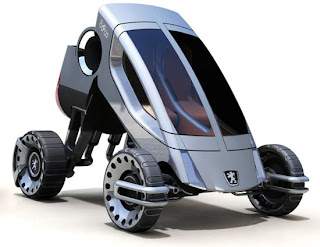
Showing posts with label Peugeot. Show all posts

Peugeot Electric Scooter, E-Vivacity (2010)


Peugeot released an electric version of the scooter, called the E-Vivacity. Electric model is, at least, analogous to 50 cm3 petrol scooter. Peugeot E-Vivacity is equipped with a lithium-cobalt battery capacity of about 4 000 watts, allows scooters on a single charge to overcome the 80 … 100 km.


The electric motor is capable of independently recharged during braking.

Under the driver’s seat has a board cable, with which you can recharge the batteries through an ordinary electrical outlet (230 V). Full charge the battery takes about four hours.


Specifications – synchronous motor with air cooling (equivalent to 50ss), the battery weight – 25kg., Transmission – gear, 32 mm front fork, front brake – Disk 200 mm., Rear brakes – a disc of 190 mm., Dimensions 1910 x 680 x 1168 mm., height – 786 mm., weight – 115 kg.

2009 Peugeot HYbrid3 Evolution


At the 2009 Milan International Cycle and Motorbike Show, Peugeot will present a new scooter concept: The Peugeot HYbrid3 Evolution. Practical and safe thanks to its three-wheel drive capability and offering a high level of performance (36 kW / 49 bhp), it offers original versatility and emits only 48 g/km of CO2 in the combined cycle or zero in electric mode, thanks to its innovative hybrid technology.


A further illustration of Peugeot’s innovative mobility solutions Visitors to the 67th Milan International Cycle and Motorbike Show will discover, from 10 to 15 November 2009, the Peugeot HYbrid3 Evolution concept.

With its three wheels, this concept is positioned between two clearly distinct worlds: that of the scooter and that of the car. The Peugeot HYbrid3 Evolution is a roofless version of the Peugeot HYmotion3 Compressor Concept, presented at the 2008 Paris Motor Show. It has in its genes therefore the ability to meet the expectations of different potential customers.

This new “concept-scooter” is based on the far-reaching experience of Peugeot Motorcycles in the world of the scooter and on the superb creative and innovative skills of Automobiles Peugeot stylists and engineers.

With an electric motor in each of its two front wheels and a naturally aspirated engine at the rear, it uses hybrid technology solutions to achieve its 3-wheel drive capability.

This new study, following the example of the 100% electric vehicles presented at the 2009 Frankfurt Motor Show (Peugeot BB1 project and Peugeot i0n to be launched at the end of 2010), further illustrates Peugeot’s ability to offer a solution perfectly adapted to the diverse needs of urban mobility.

The design base

The architecture of the Peugeot HYbrid3 Evolution is based on the concept of three wheels for stability, safety and maximum driveability. Its width of 82 cm allows it to adapt to urban traffic while still retaining the efficiency of a two-wheeler.

Its suspension and structure are designed to accommodate the hybrid technology and the two electric motors in the front wheels. The front suspension, consisting of deformable parallelograms (i.e. wheels that incline) has at its centre a transverse damper for optimal driveability and stability. The suspension assemblies are positioned on the wheel hub. Like a low-slung tubular chassis, reducing the height of the vehicle’s centre of gravity.

For optimal safety the brakes incorporate an ABS system coupled with a linked integral braking system (PBS) which acts simultaneously on the rear wheel and the two front wheels. The braking system operates by means of three ventilated discs and, in addition, via the front electric motors which in this way recover energy to recharge the batteries. This assembly (3 wheels + electric motor braking) also makes it possible to reduce the braking distance by around 30 % compared to a two-wheel scooter equipped with traditional brakes.

Style

Based on a 3-wheel chassis specifically designed by Peugeot Motorcycles, Peugeot’s car stylists created a resolutely elegant and avant-garde design.

The front suggests modernity, with panels of light emitting diodes located on either side of the base of the front windscreen. These ensure highly efficient lighting and as a result the ability to be seen more clearly in traffic.

Finely chiselled front mud guards, taut style lines, rear lights with a hi-tech finish. Each detail accentuates the vehicle’s dynamic credentials.

Hybrid technology

The petrol engine providing the concept’s rear wheel drive has an output of 30 kW (41 bhp). This is a new 300 cm3 compressor engine. It is compact and benefits from the PSA Peugeot Citroën Group’s ‘downsizing’ strategy: linked to a compressor, it obtains the performance of a 500 cc whilst controlling the level of CO2 emissions.

In addition to rear-wheel drive, the vehicle also has another drive mode. Two electric motors, one in each wheel, are present at the front of the vehicle. With an output of 2×3 kW, they are powered by lithium-ion batteries which can be recharged by an energy recovery system active during deceleration and braking.

As a result there are no mechanical connections between the front and the rear, with everything controlled electronically (“by wire”), which works in favour of the vehicle’s compact size.

The Peugeot HYbrid3 Evolution can, therefore, be driven in a number of different ways:

* in electric only mode (start-up, low speed and deceleration, offering a range of up to 10 km)
* in petrol only mode, at stable speed on the open road, when the petrol engine attains its optimal efficiency
* petrol engine/electric motor combined, with the design of this electric/petrol hybrid allowing three-wheel drive for enhanced safety and driveability under all circumstances
* as required by road conditions
* during phases of acceleration for extra power (“boost” function) and grip, when the power can attain a maximum of 30 + (3×2) = 36 kW (49 bhp).

These characteristics allow acceleration and in-gear acceleration equivalent to that obtained with a single 500 cm3 engine (the Peugeot Satelis for example).

Another system contributing to the vehicle’s overall efficiency is STOP & START. This places the petrol engine on standby when the vehicle is at a standstill (at traffic lights, a stop sign or in traffic jams) or when the vehicle is being driven in electric mode.

This technology allows for significant gains in terms of fuel consumption and emissions, especially when traffic is particularly heavy. It also means that the petrol engine can be restarted instantly and imperceptibly for the driver as and when necessary. It will be noted that when driven in electric-only mode, the Peugeot HYbrid3 Evolution is the perfect “good citizen”, as it then produces no CO2 emissions whatsoever and becomes silent.

Finally, the Peugeot HYbrid3 Evolution keeps fuel consumption in the standardised cycle to a minimum, at 2.0 litres/100 km for 48 g/km of CO2!

This hybrid technology and its original implementation is one of Peugeot’s technologies of the future. The Marque could for example make it available in different forms with different naturally-aspirated engines, different electric solutions and on any type of vehicle, even the smallest models.

From 2011, the HYbrid4 3008 will be the Group’s first vehicle to be sold with an HDi engine at the front and an electric motor at the rear.


Electric Vehicles, Hybrid Technology, HYbrid3 Evolution, Peugeot, Peugeot HYbrid3 Evolution, Peugeot Motorcycles

Peugeot Reveals New Lion Emblem - Evolution of the Logo from 1847 to Today


Jean-Pierre and Jean-Frédéric Peugeot turned their father's cereal mill into a steel foundry and eventually, to a motorcycle and automobile manufacturer. In celebration of the firm's 200th anniversary, Peugeot has announced a new look for its cars - previewed through the SR1 Concept that will be revealed at the Geneva Show - and a new interpretation of its Lion emblem.

The updated Lion, which is now three-dimensional and looks more dynamic and supple, will make its vehicle debut on the new Peugeot RCZ sports coupe launched in the Spring. If you hit the jump, you can read about the birth and the evolution of the Lion emblem from 1847 to today.


From Peugeot Press Release:


The origin of the Lion


The Lion emblem was first conceived in 1847 when Jules and Emile PEUGEOT, who founded the company Peugeot Frères, asked Julien BLAZER, a jeweller and engraver, to produce a logo for identifying all PEUGEOT products.


The chosen design was a Lion, as the characteristics of the Lion were very similar to those of the saws the Peugeot brothers were producing:


Strong teeth like those of the Lion.


Suppleness of the blade like the Lion's spine.


Swiftness of cut like the Lion pouncing on its prey.


The Lion quickly became Peugeot's sole registered trade mark, and could be found not only on tools and saw blades, but also on coffee grinders by 1881 (the production of which began in 1840), on bicycles from 1882 and, from 1898, on motorcycles.


The Lion becomes a part of automotive history


Although the first Peugeot production car the Type 3, built by Armand PEUGEOT dates from 1891, it was only in 1906 that the emblem first appeared on a production car.


In 1910, the two entities (PEUGEOT Frères and Armand PEUGEOT) merged to become La Sté des automobiles et cycles PEUGEOT; the two product ranges, however, co-existed until the First World War.


The last car to display the "Lion walking on an arrow" was the Bébé Lion (designed by Ettore Bugatti), presented at the Paris Motor Show in October 1912.


Subsequent models, however, used old-style lettering, on the top of the radiator grille contained inside a double "ellipse", and in some instances with lettering also on the radiator, either on its own or in a coat of arms (from the 201).


In the 1920s the Lion became a rallying call for "Peugeotistes" who used it as a decoration on their radiator caps. Two types of radiator Lions were distributed in the network, a roaring version by the sculptor Marx and one ready to pounce by Baudichon.


For its part, Peugeot bicycles and motorcycles first used the Lion "walking on an arrow" emblem against the background of a spoked wheel; later a fighting Lion facing to the right was introduced in the 1920s and, finally, the same design but with upright lettering in 1960. Tools and domestic appliances opted for the Lion "walking on an arrow" in a coat of arms or on an oval plaque for coffee grinders.


From October 1933, with the launch of the "aerodynamic" range of Peugeot vehicles 201, 301 and 601, a Lion's head re-appeared on the top of the radiator grille.


This design also appeared on the 401, first seen at the 1934 Paris Motor Show and with a tapered head design on the 402 (1935) then the 302 (1936) and the 202 in 1938.


In 1948, the 203 adopted as its figurehead a Lion on the bonnet in a more prominent style. With the launch of the 403 in 1955 another new Lion appeared on the bonnet, however, these two designs were deemed too dangerous in the event of a collision and soon disappeared in September 1958.


The launch of the 203 also marked the first appearance of the heraldic Lion of Franche-Comté and the Duchy of Montbéliard.


It was attached to the boot lid until October 1952 and then migrated to the front of the bonnet from September 1958 until the end of the series in February 1960. During this period the heraldic Lion also appeared on PEUGEOT motorcycles.


The same design of the Lion was also placed in a small coat of arms in the centre of the radiator grille on the 403 range from April 1955 to 1966 before being replaced by a larger version, which first appeared on the Pininfarina styled 404, in May 1960.


It was then replaced by a Lion (gilt or chrome-plated) leaping from its background, which first appeared in September 1968 on the 504, then was adopted by the 404, 204, 304 and 104.


Another generation, the Lion "in outline" appeared on the 604 marketed in September 1975, and then extended to the 305 (November 1977) and 505 (May 1979) before being presented on a black background in 1982 on the 205, through to the 306 in 1993.


At its launch in October 1995, the 406 stood out with its large Lion emblem which rapidly migrated across the entire "six" generation models. This led in 1998 to a new look Lion, with a stylised, angular appearance that decorated the front and rear of both Peugeot cars and scooters.


Now in 2010, the Peugeot Lion, which has been associated with the brand for the last 152 years, has evolved again with a new more dynamic look. Combining a new bi-metallic finish it is now simpler in design, with a new posture and fluidity. The first production vehicle to display this new Lion will be the Peugeot RCZ which will be launched in April.